Multimodal Vector Database for Image, Video & Text
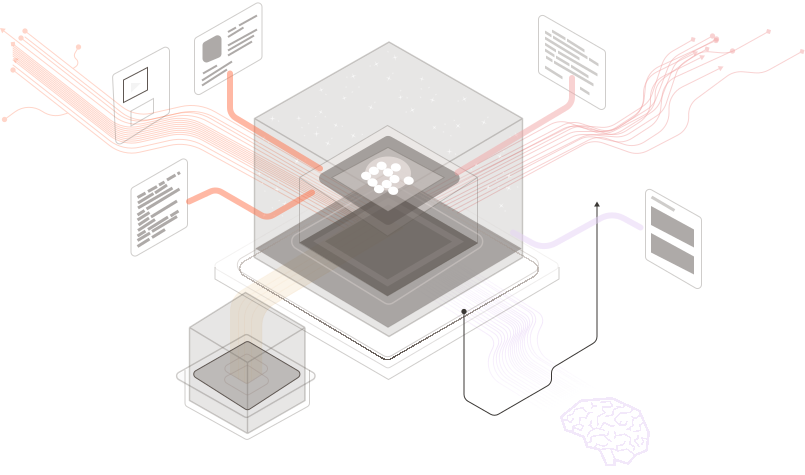
LanceDB is a multimodal vector database that keeps images, video, audio, text, metadata, and embeddings in one engine.
Instead of wiring together a complex setup involving SQL databases and separate layers for embeddings, metadata and multimodal data, LanceDB collocates everything, including image, video and audio binary blobs – meaning simpler governance, less I/O and better performance.
Product and platform teams get:
- One place to store and query multimodal data
- Consistent schemas with native support for several media types, in addition to text and standard types
- Lower latency and less glue code for GenAI and RAG workloads
Hybrid Search Combining Dense and Sparse Vectors
Good multimodal search needs more than a single embedding column.
LanceDB’s vector search engine combines dense vectors, sparse vectors, and keyword scores in one query:
- Dense vectors capture semantics across text, images, and audio
- Sparse vectors and keyword indexes keep exact IDs, terms, and phrases visible to the reranker
- LanceDB hybrid search combines the best of both worlds, producing results with increased relevance
Fast and scalable hybrid search provides teams the following benefits:
- Run semantic queries across images, video frames, and documents in one engine
- Avoid maintaining brittle integrations across multiple systems for semantic search, full-text search and vision inference
- Keep all signals aligned at the row level, in the same multimodal vector database table
Vector search becomes a retriever pattern, not a separate infrastructure project.
Native Vector Search Filtering In Your Lakehouse
Multimodal workloads are driven by metadata: customer, region, time range, labels, and flags. If filters live in application code or a separate SQL database, every vector search call gets slower, more complex, and more expensive.
In LanceDB, vector search and filtering run directly against Lance tables stored in your S3 or lakehouse, under your account:
- Data and indexes live together in your object storage, not in a proprietary remote service
- No double storage for “lake + vector database”; you write data once and query it in place
- Storage and compute scale independently, so you can right-size query engines instead of paying for big always-on clusters
Because filtering runs close to the data, you avoid:
- Slow post-filter steps in your API layer
- Extra round trips between a SQL database, a data lake, and a vector index
- Inconsistent filter logic spread across services
The result is a cleaner retrieval path where metadata filters and multimodal similarity are handled together, using one vector search stack that lives inside your existing lakehouse.
Built for a Variety of Use Cases Across Domains
Many search stacks operate largely on text data only. LanceDB is multimodal-first, and is designed for multiple workloads, on several formats of data, in multiple domains.
Use cases that LanceDB supports:
- Vision model inference: Find similar results from photos or videos while querying in natural language, using the capabilities of modern VLMs
- Autonomous vehicles and sensor-heavy systems: Aligning visual, spatial, and telemetry streams so ML engineers can search and retrieve from complex nested data.
- GenAI and multimodal RAG: Retrieving charts, diagrams, screenshots, or video frames that belong next to a text answer, from a single source of truth
LanceDB handles a diverse set of AI workloads, not just search and retrieval. It supports multiple access patterns that enable analytics, feature engineering, exploratory data analysis and training workloads, in addition to traditional search.
Manage the Full Retrieval Stack
LanceDB is built to own the retrieval layer for multimodal AI, not just one feature.
With LanceDB, teams can:
- Store images, video, audio, text, metadata, and embeddings in a single LanceDB table
- Run search over dense and sparse vectors plus keywords in one request
- Use native vector search filtering to keep every query scoped to the right tenant, region, or workflow
Instead of stitching together multiple databases and indexes, you get one multimodal vector database designed for modern AI products.