AI’s most visible breakthroughs arrive as generated videos, simulated worlds, intelligent search, and machines that can act in the physical world. Behind each one is a less visible layer of work that determines what the model can actually learn.
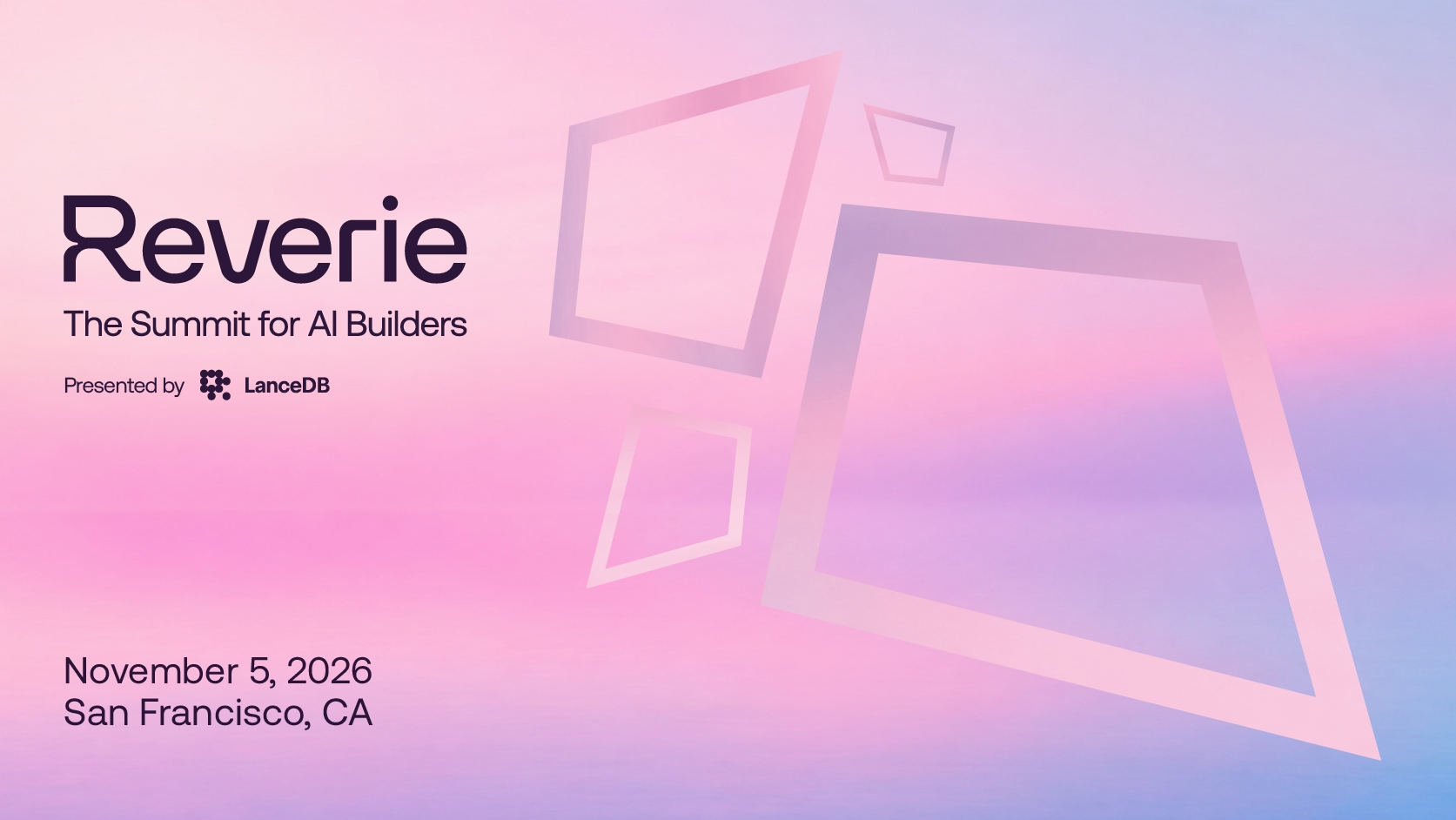
On November 5, speakers from NVIDIA, Runway, Microsoft AI, Applied Intuition, Adobe, Exa, Luma AI, Zoox, Cruise, XPeng, Tubi, and LanceDB will join 200 AI researchers, engineers, and technical leaders in San Francisco for Reverie, a one-day summit about that work and the people doing it firsthand.
Reverie goes inside the systems beneath the models. The people building these systems will share the architectures they chose, the tradeoffs they made, the experiments that failed, and the lessons they learned at scale.
The frontier has moved below the model
The next breakthrough will not come from compute alone. It will also come from making better use of the data and compute teams already have.
That means finding the few valuable examples hidden among billions of frames. It means enriching raw video, images, audio, and sensor data with embeddings, captions, trajectories, quality scores, and other features. It means building evaluation sets that distinguish genuine understanding from surface-level imitation. And it means shortening the loop between discovering what a model is missing and training on the data that can teach it.
For many frontier teams, this is now where model quality is made. Reverie puts that work on stage.
What you will hear at Reverie
The program spans the comprehensive research and data loop, from building omnimodal world models and curating higher-quality training sets to operating petabyte-scale autonomy pipelines, enterprise multimodal platforms, and web-scale search infrastructure.
Below is a preview of the themes and speakers shaping the day. See the full Reverie schedule for session times, complete talk details, and the latest additions.
The model is only as good as the data it can learn from
The day will answer the question, What Will AI Dream Next? by looking beneath the models themselves. In Cosmos: Omnimodal World Models for Physical AI, NVIDIA Cosmos Lab Tech Lead Max Li will show what it takes to bring language, images, video, audio, and action into a shared foundation that can serve robotics and autonomy. At roughly a million hours of video and tens of billions of training candidates, Cosmos 3 makes the connection between model ambition and data infrastructure impossible to ignore. Its data must be filtered, enriched, inspected, and delivered to large GPU clusters continuously, with NVIDIA’s SILA platform using Lance as a common substrate across the workflow.
More data and more modalities do not automatically produce better intelligence, however. Runway Principal Research Engineer Ethan Rosenthal will pick up that thread in Scalable, Multimodal Data Curation, showing how embeddings, semantic deduplication, and large-scale similarity search help the team improve quality and diversity without giving up scale. Yichen Wang of Luma AI brings another perspective from the frontier of generative video, where what goes into a training set shapes not only what a model can generate, but how well it understands motion and the visual world.
The data layer is becoming the research loop
Once the right data has been found, it still has to move through curation, feature generation, search, training, evaluation, and then back through the cycle again. Suqiang “Jack” Song, Head of Data Platform at Microsoft AI, gives that loop its clearest frame in Building the Data Flywheel for Frontier AI Model. His session follows multimodal data through preparation, deduplication, decontamination, pretraining, and low-latency search, showing why teams need to bring different kinds of compute to the same durable data instead of rebuilding the foundation for every workload. Adobe’s Jing Chen He and Miao Wang extend that idea into the enterprise with How Adobe Built a Multimodal Lakehouse for AI-Native Experiences, where structured data, conversations, embeddings, and multimodal assets must come together without leaving behind governance, change data capture, or data-residency requirements.
The same pattern appears in very different domains. In Tubi’s Cornucopia: Serving Up Every Modality of Data at the AI Feast, John Trenkle will show how keeping media, metadata, embeddings, and derived signals together in one expandable table makes content easier to search, enrich, and reuse across analytics, machine learning, and agents. Exa pushes the idea to web scale. Jan van der Vegt’s Managing an Index of 100s of Billions of Pages with Exa Skeleton goes inside a distributed streaming engine that ingests billions of crawls a day and supports massive column backfills without rebuilding production datasets. Together, these talks tell a larger story about the data layer becoming an active part of the research process rather than a passive place to store its outputs.
Physical AI makes every bottleneck visible
The research loop becomes concrete when models have to operate in the physical world. Applied Intuition Software Engineer Shiyan Xu will trace raw driving logs into searchable, versioned data for hard-example mining, scenario discovery, and reinforcement learning in From Raw Driving Logs to RL Training: A Petabyte-Scale Lance Pipeline in Production. The pipeline has to evolve as new data arrives and definitions of useful training data change, while still feeding large multimodal samples directly into training. Zoox HPC Engineer Adharvan Jakkula approaches the same challenge from the storage layer in Beyond HPC Storage: S3-Native Training Without the Performance Tradeoff, exploring how teams can move demanding training workloads toward object storage without surrendering the throughput they need.
One day, one connected research loop
The same data moves through collection, inspection, enrichment, retrieval, training, and evaluation, but those stages have traditionally been split across different formats and systems. As multimodal datasets grow, the seams between those systems increasingly slow the research itself.
Reverie is a chance to hear how leading teams are closing those gaps in practice. Expect technical architectures, hard-won lessons, production numbers, and candid conversations about what worked, what broke, and what the next generation of AI infrastructure will need.
What dreams are made on
The models get the attention. Reverie is about the work that makes them possible.
The raw artifacts and the derived features. The hard cases and the failed experiments. The evaluation sets, training pipelines, and data engines. The researchers and engineers who turn an idea into evidence, then turn that evidence into the next model.
Reverie takes place Thursday, November 5, 2026, at the Contemporary Jewish Museum in San Francisco. Capacity is limited. Explore the full schedule and apply to attend to join the people building what AI will dream next.